As new-energy equipment moves toward higher system voltages and more compact electrical layouts, cable selection becomes more than a question of conductor size. Voltage rating, insulation material, operating temperature, routing method and environmental exposure all affect whether a cable is suitable for the job.
Rolan Cable's 1500V EV high-voltage XLPE cable is a flexible, single-core wire designed for fixed internal connections in compatible electric vehicle systems, charging equipment, new-energy devices and industrial electrical assemblies. Its compact two-layer construction combines a fine-stranded copper conductor with cross-linked polyethylene insulation.
This guide looks at six practical applications for the cable, the main specifications buyers should check, and the installation limits that should be understood before ordering.
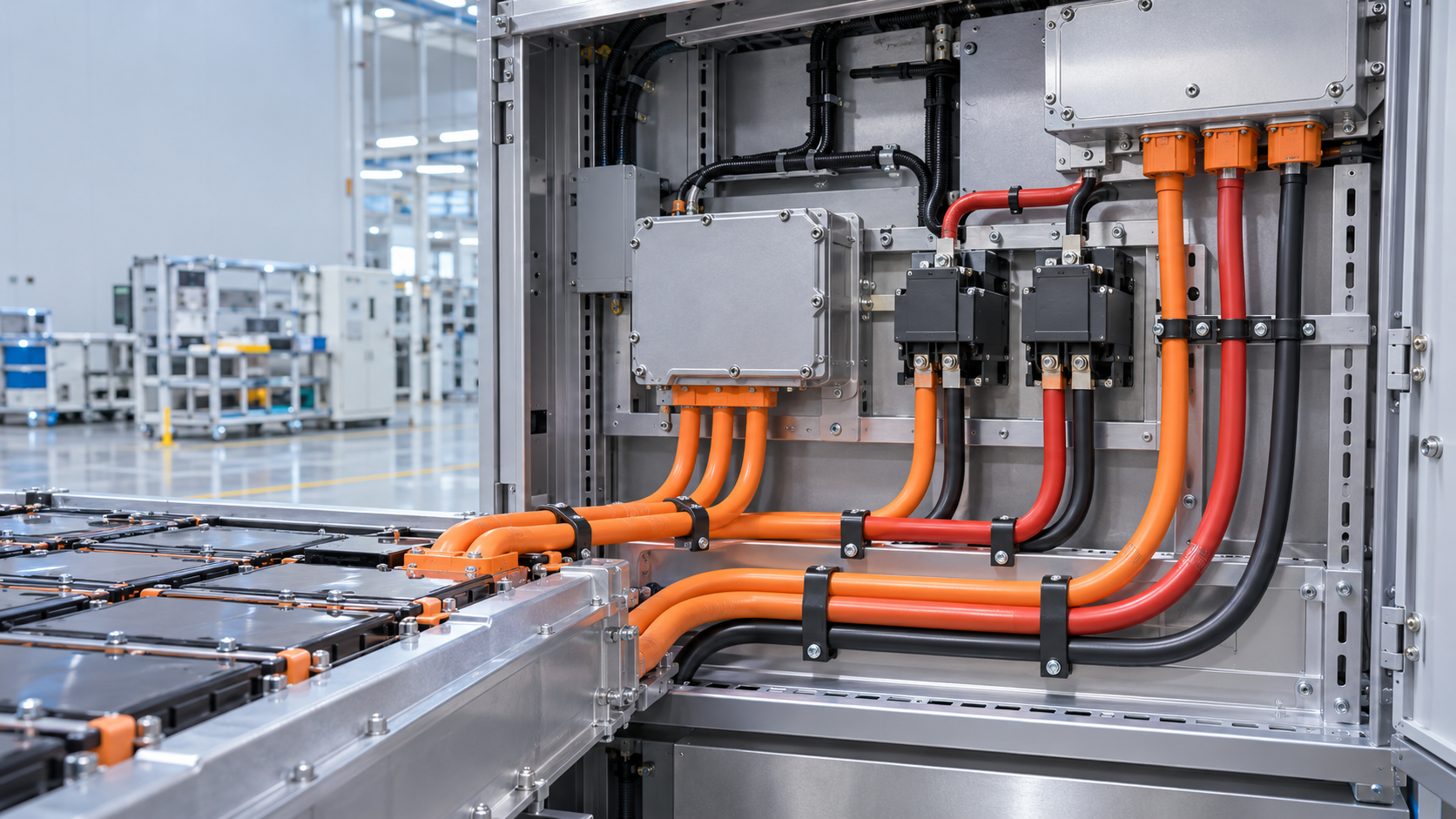
A 1500V voltage rating does not select the cable by itself. Current, conductor size, temperature, routing and installation type must also be confirmed.
This EV cable uses a fine-stranded oxygen-free copper conductor covered directly with cross-linked XLPE insulation. It is a single-core, unshielded construction with no separate inner sheath and no additional outer jacket.
The fine copper strands make the wire easier to route during equipment assembly than a solid or coarse-stranded conductor. XLPE provides electrical insulation together with heat, flame and oil resistance for compatible industrial environments.
The standard product is rated at 1500V and has a stated operating range of approximately −40°C to +125°C, with short-term exposure up to 150°C according to the supplied product information. Standard conductor sizes range from 0.5mm² to 16mm².
Although the conductor is flexible, the standard cable is intended for fixed installation. It should not automatically be specified for drag chains, robotic axes, repeated torsion or other continuous-motion applications.
Power conversion units, battery-related equipment and other new-energy assemblies often need compact single-core wiring between internal components. In these applications, a 1500V XLPE wire can connect terminals, distribution points, protection devices and power modules where the equipment design calls for fixed wiring.
The single-core structure makes it easy to route positive, negative, protective-earth and auxiliary circuits separately. Standard insulation colours can also help technicians identify circuits during production and maintenance.
Before selection, confirm the system voltage, maximum current, fault-current conditions, enclosure temperature and the required creepage and clearance distances. Cable voltage rating does not replace the insulation coordination requirements of the complete equipment.
Electric vehicles contain a range of electrical circuits, but not every orange or high-voltage wire serves the same purpose. A single-core XLPE cable may be used for compatible fixed connections in EV electrical or auxiliary assemblies when its voltage, temperature, size and construction match the vehicle design.
The cable should not be assumed to replace a shielded traction cable, a multi-layer battery cable or an automotive cable qualified to a different standard. Vehicle vibration, abrasion, fluids, connector sealing and electromagnetic compatibility all need separate evaluation.
For OEM projects, send the cable manufacturer the actual circuit function and routing location. This allows the supplier to determine whether the standard two-layer EV wire is appropriate or whether a shielded, sheathed or specially tested construction is required.
Charging equipment contains internal high-voltage connections between input protection, rectifier modules, DC distribution components and output assemblies. A 1500V single-core wire can be considered for fixed internal wiring where its current capacity and temperature rating meet the equipment design.
This is different from the external charging cable handled by the vehicle user. External charging cables normally need multi-core construction, mechanical protection, repeated flexing capability and a complete connector system. The EV XLPE wire discussed here is intended for internal fixed connections rather than as a finished charging-gun cable.
Inside a cabinet, check conductor size, bundling, ventilation, proximity to heat-producing components and terminal compatibility. Several loaded conductors installed closely together may need different thermal consideration from a single wire tested in open air.
Industrial power cabinets and new-energy control panels may require higher-voltage single-core connections between bus components, contactors, protection devices and power electronics. Fine-stranded copper makes routing and terminal preparation more convenient, while colour options support circuit identification.
However, the installer must protect the insulation from sharp panel edges and excessive pulling force. The minimum permitted bend radius, terminal type and stripping method should be confirmed with the cable and connector suppliers.
If electromagnetic interference is a concern, remember that the standard cable is unshielded. The cabinet designer may need physical separation, grounded metal enclosures or a different shielded cable construction depending on the circuit.
The cable can also be used for compatible fixed electrical connections inside industrial machines, CNC equipment and production systems. Its temperature and oil resistance can be useful where wiring is routed inside protected equipment areas.
“Flexible conductor” does not mean “continuous-flex cable.” A wire installed once inside a stationary cabinet has a different mechanical duty from a cable that moves with a machining axis. For drag chains, cable reels or repeated robotic motion, use a cable specifically designed and tested for that movement.
Also review possible contact with cutting oil, coolant and metal chips. The product may be oil-resistant, but chemical compatibility and exposure duration should be confirmed for the actual fluid and application.
XLPE-insulated wire can be useful inside electrical appliances and heating-related equipment that require higher temperature resistance than ordinary PVC wiring. Potential applications include fixed internal connections near power modules, heating assemblies and temperature-controlled equipment.
The complete installation still needs to remain within the cable's approved operating conditions. Distance from heating elements, local hot spots, terminal temperature and enclosure ventilation should all be checked. A general ambient-temperature rating should not be treated as permission for direct contact with a heater or other hot surface.
The standard EV single-core cable is rated at 1500V. Confirm whether the project specifies AC or DC conditions, the applicable equipment standard and any required test voltage. The cable rating must match the complete electrical system and local compliance requirements.
Standard sizes range from 0.5mm² to 16mm². Choose the conductor using the continuous current, permissible voltage drop, circuit length, installation method, grouping, ambient temperature and terminal rating.
| Conductor size | Reference finished diameter | Standard conductor structure |
|---|---|---|
| 0.5mm² | 2.2mm | 16 / 0.20AS |
| 1.0mm² | 2.8mm | 32 / 0.20AS |
| 2.5mm² | 3.6mm | 79 / 0.20AS |
| 4mm² | 4.6mm | 80 / 0.25AS |
| 6mm² | 5.6mm | 120 / 0.25AS |
| 10mm² | 6.5mm | 200 / 0.25AS |
| 16mm² | 8.0mm | 320 / 0.25AS |
These diameters and conductor structures are reference values from the standard product table. Final dimensions may vary with manufacturing tolerance or customization.
The published operating range is approximately −40°C to +125°C, with 150°C short-term exposure. Buyers should confirm how the temperature is defined, whether the cable is continuously loaded and what derating applies inside bundles or enclosed equipment.
The standard product is specified for fixed wiring. Occasional bending during assembly is not the same as millions of repeated movement cycles. If the cable moves during normal machine operation, provide the bend radius, speed, acceleration, travel and expected cycle life so that a motion-rated cable can be evaluated.
This cable has no metal braid, foil, inner sheath or separate outer sheath. That keeps the construction compact, but it also means the installer must evaluate electromagnetic interference and mechanical exposure.
Where the wire may rub against metal, encounter sharp edges or be exposed outside an enclosure, conduit, sleeving or a different sheathed cable may be necessary. If the circuit requires shielding, select a product designed with an appropriate screen and grounding method.
Standard colours include red, black, blue, yellow, green and yellow-green. Define the colour for each circuit before production and follow the applicable wiring convention for the destination market. Colour is useful for identification, but it does not prove voltage rating, polarity or compliance on its own.
Cross-linking changes the molecular structure of polyethylene and improves its performance at elevated temperatures. In practical cable construction, XLPE can provide a combination of electrical insulation, heat resistance and mechanical stability.
For fixed internal wiring, the main benefits include:
These advantages still depend on correct installation. XLPE is not a substitute for abrasion protection, shielding, connector sealing or movement-rated construction where those features are required.
| Item | EV XLPE cable information |
|---|---|
| Model | EV |
| Rated voltage | 1500V |
| Number of cores | Single core |
| Conductor | Fine-stranded oxygen-free copper |
| Insulation | Cross-linked XLPE |
| Size range | 0.5mm²–16mm² |
| Operating temperature | Approximately −40°C to +125°C |
| Short-term temperature | Up to 150°C, subject to confirmed conditions |
| Shielding | None |
| Separate outer sheath | None |
| Installation type | Fixed installation |
| Standard colours | Red, black, blue, yellow, green and yellow-green |
To receive an accurate specification and quotation, provide:
For OEM production, samples can be used to confirm stripping, crimping, routing and colour identification before bulk manufacturing.
It is a single-core XLPE-insulated wire without shielding or an additional outer sheath. Whether it is suitable for a battery connection depends on the vehicle or equipment design, current, protection, routing, terminals and applicable standards. Do not assume that every EV battery circuit uses the same cable construction.
The standard product is intended for fixed installation and is not specified as a continuous-flex drag-chain cable. Moving applications require a purpose-designed cable selected using the actual motion data.
No. It has no metal braid or aluminium-foil screen. If the circuit requires EMC shielding, use an appropriate shielded cable and termination system.
Fine copper strands make the wire easier to route and terminate during equipment assembly. This installation flexibility should not be confused with continuous-motion capability.
Depending on technical review and order quantity, conductor size, strand structure, insulation thickness, colour, printing, metre marking and coil length can be customized.
A 1500V rating and XLPE insulation provide a useful starting point, but they do not complete the selection process. The correct cable must also match current, temperature, routing, mechanical protection, circuit identification and installation type.
Review the 1500V EV high-voltage XLPE cable, then send your voltage, current, conductor size, operating temperature, colour, cable length and order quantity through the Contact Us page. Rolan Cable can evaluate the application and provide a suitable specification, sample and factory quotation.


